Near Earth Objects
Earth shouldn't be our only concern

It is not uncommon to come across a news item concerning space objects hurling through the cosmos toward Mother Earth. So far in our modern age, none comes close enough to generate genuine concern about an impact. All such articles mentioned only one concern: an Earth impact.
There are discussions about possible remediation to such threats but no consensus. We hear ideas ranging from forward strikes with nuclear weapons, to course diversion via deep space impacts or solar energy techniques. In theory some have merit, given enough time to implement, but the fact is, often science doesn’t see the threat in time for any of these ideas to work, assuming they could work.
Let me tell you something you are hearing about for the first time. There is another threat none of the geniuses directing space agencies or government programs have thought of: what happens if a near Earth object strikes our moon and alters its characteristics relative to Earth? It could be catastrophic.
Our moon is responsible for the rhythmic seasons life on Earth depend on. Our moon keeps Earth on her axis that causes our seasons.
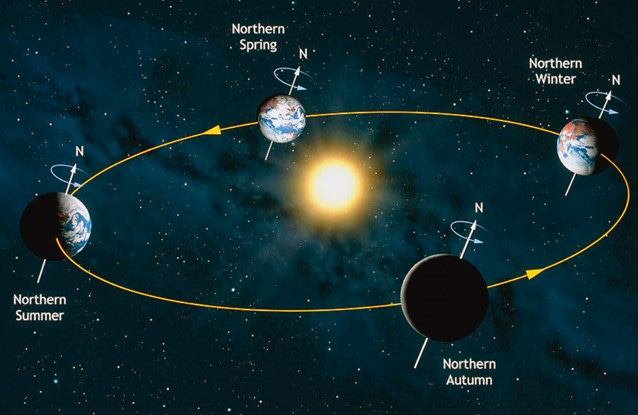
Our Earth rests on a constant 23.5⁰ axis as she travels around our Sun. Moving left to right, the image explains how we have summer in the North, then 6 months later when our Earth is on the direct opposite side of her orbit around our Sun, we get winter in the North as she tilts away from our sun. That tilt is constant and only possible because of forces exerted by our moon
Without our moon, Earth would wobble unpredictably. We would not have regular seasons. That would affect growing crops. We would have far less food. The moon may shield us from a direct hit, but millions could starve because of a change in our moon’s orbit.
If a large enough object strikes our moon this delicate balance could be threatened. This is why I am suggesting any computations concerning near Earth objects should also include our moon and any plans to deal with such a threat should also include threats to our moon.
Saturn and Jupiter play a role in protecting Earth from objects entering our inner solar system. The immense gravity of these planets acts as a vacuum cleaner of our solar system, but they can’t be everywhere. It is not a matter of if, but rather a matter of when we will take a hit.
Recently, we have experienced visitors to our solar system named Oumuamua and 3I/ATLAS. These have entered our solar system unlike objects we have seen before in that they are not on the common orbital plane of the planets but enter and exit at an obtuse plane indicating that they are not of our solar system. Put another way, these are deep space objects hurled toward us from a far by a powerful galactic source or event.
Oumuamua struck our solar plane at an angle of about 20⁰, which is not considered possible from an object originating from the asteroid belt. She was a visitor to our solar system from afar, much afar.
We should expand our thinking to widen the scope of what is considered a threat to Earth to include our moon.
Before I close, I would like to take a moment to scoff at the idea some have proposed that Oumuamua was a vessel of sorts sent here by aliens to spy on us. It doesn’t make sense to send a spy vessel on such a trajectory. It would make more sense to mimic our orbital plane to appear as an object from the asteroid belt. Such an object would draw far less attention provided it posed no threat to Earth. Don’t get me wrong, I get all kinds of entertainment from the crazies of our world who speak of such things.